
What Does a $25K vs. $50K vs. $100K Phoenix Backyard Actually Look Like?
You know you want to transform your backyard.
Maybe you're picturing a larger patio, better shade, desert planting, a fire pit, an outdoor kitchen, or simply turning an empty builder-grade yard into somewhere you actually want to spend time.
Then comes the hard question:
How much backyard does your budget actually buy in Phoenix?
What might a $25,000 backyard look like compared with a $50,000 backyard? And what changes once the number reaches $100,000?
The answer isn't as simple as attaching a price tag to a list of features. Two Phoenix homeowners could spend the exact same amount and end up with completely different backyards, depending on the size of the property, existing conditions, site access, materials, and how the budget gets prioritized.
But walking through a few realistic scenarios can help you set expectations before you start designing or collecting bids.
A note on the numbers below: These are illustrative construction-budget scenarios, not fixed packages or quotes from Desert Curb Studio. Actual installation costs vary by contractor, property, materials, site conditions, and scope. Desert Curb Studio focuses on the design and planning phase — final construction pricing should come from qualified, licensed contractors once your scope is defined. Cost ranges referenced in this article reflect published Phoenix-area contractor pricing as of September 2026 and are reviewed periodically.
In this article: what a $25K, $50K, and $100K backyard can realistically look like, what actually drives cost up, why two identical budgets can produce completely different results, and how to prioritize before you build.
Quick Answer: What Actually Changes Between $25K, $50K and $100K?
Think of these less as packages and more as levels of opportunity.
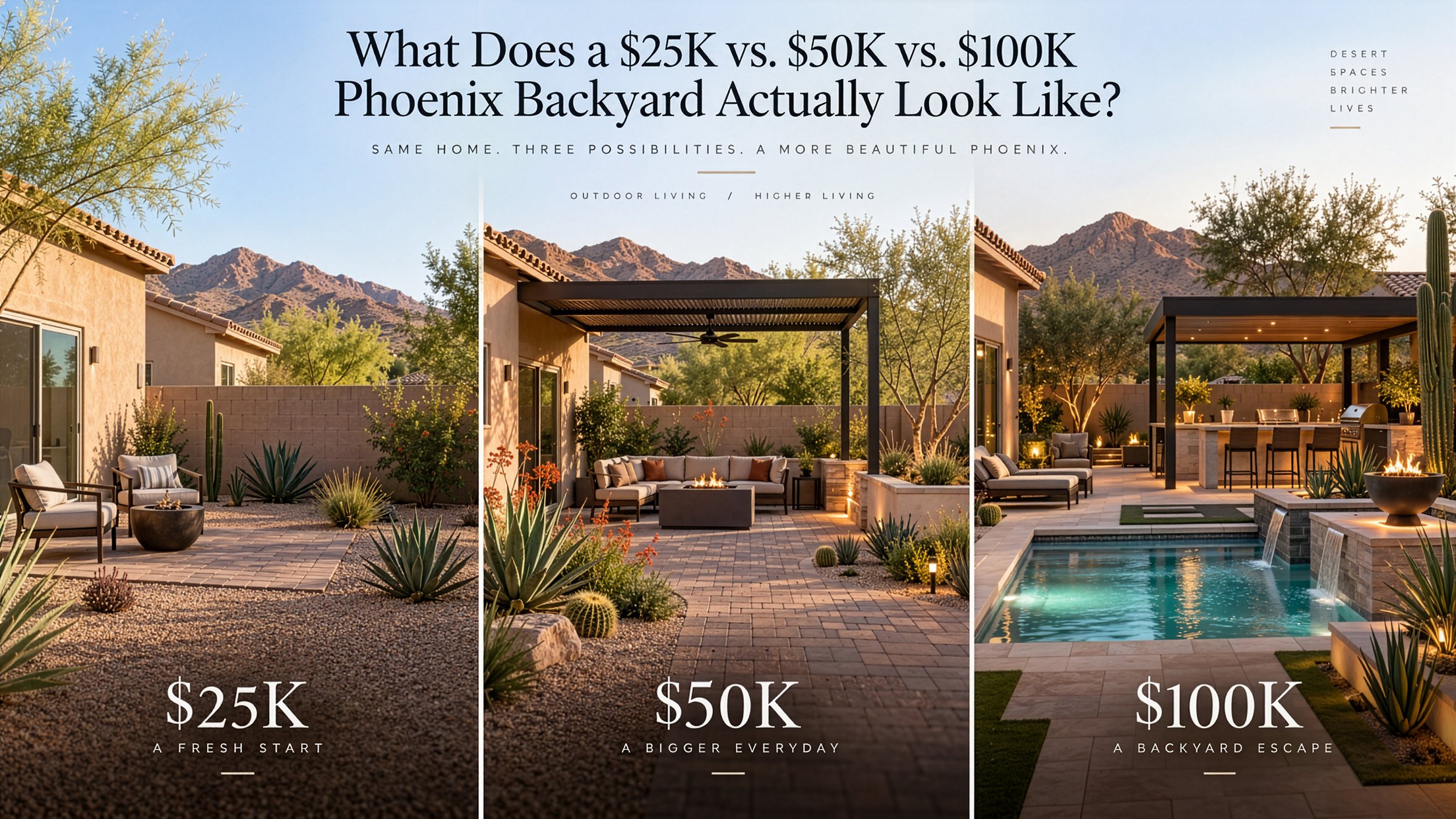
Around $25K — Focused improvement. Prioritize a few high-impact changes and make one part of the yard genuinely work.
Around $50K — Broader transformation. Connect multiple outdoor spaces with stronger hardscape, planting, shade, and lighting, plus room for one significant feature.
Around $100K — Comprehensive outdoor living. Enough flexibility to coordinate several substantial features — multiple gathering zones, upgraded materials, larger structures — into one cohesive design.
These aren't guarantees. A $50,000 budget on one property can accomplish considerably more than the same $50,000 on another — which is exactly why the design and prioritization step matters more than the number itself.
What Could a $25,000 Phoenix Backyard Look Like?
At $25,000, the smartest question isn't "how many things can we fit in?" It's:
Which improvement will actually change how this yard feels to use?
Trying to squeeze a patio, pergola, outdoor kitchen, fire feature, turf, new trees, and lighting into one modest budget usually spreads it too thin — you end up with several half-finished ideas instead of one that works.
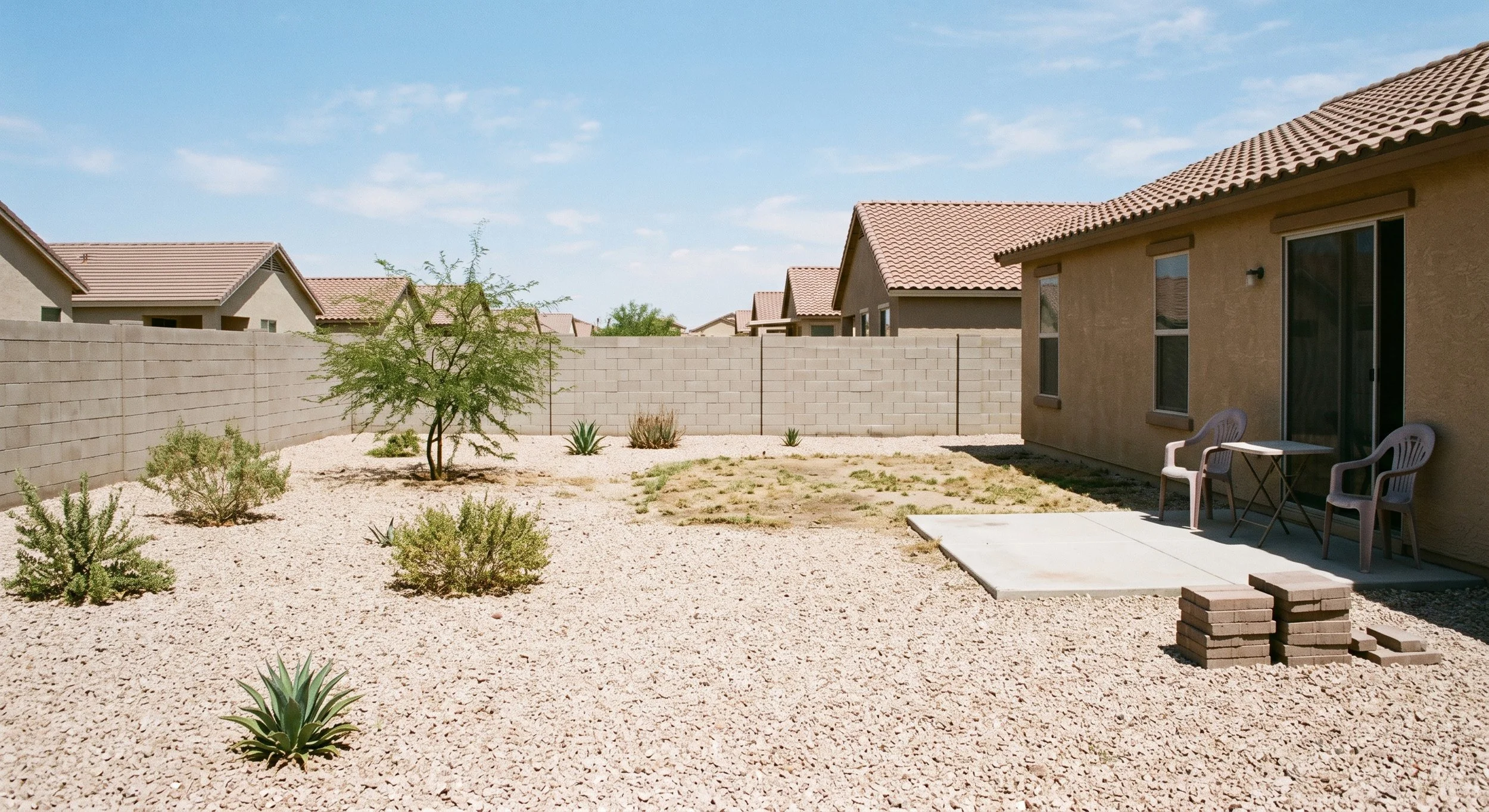
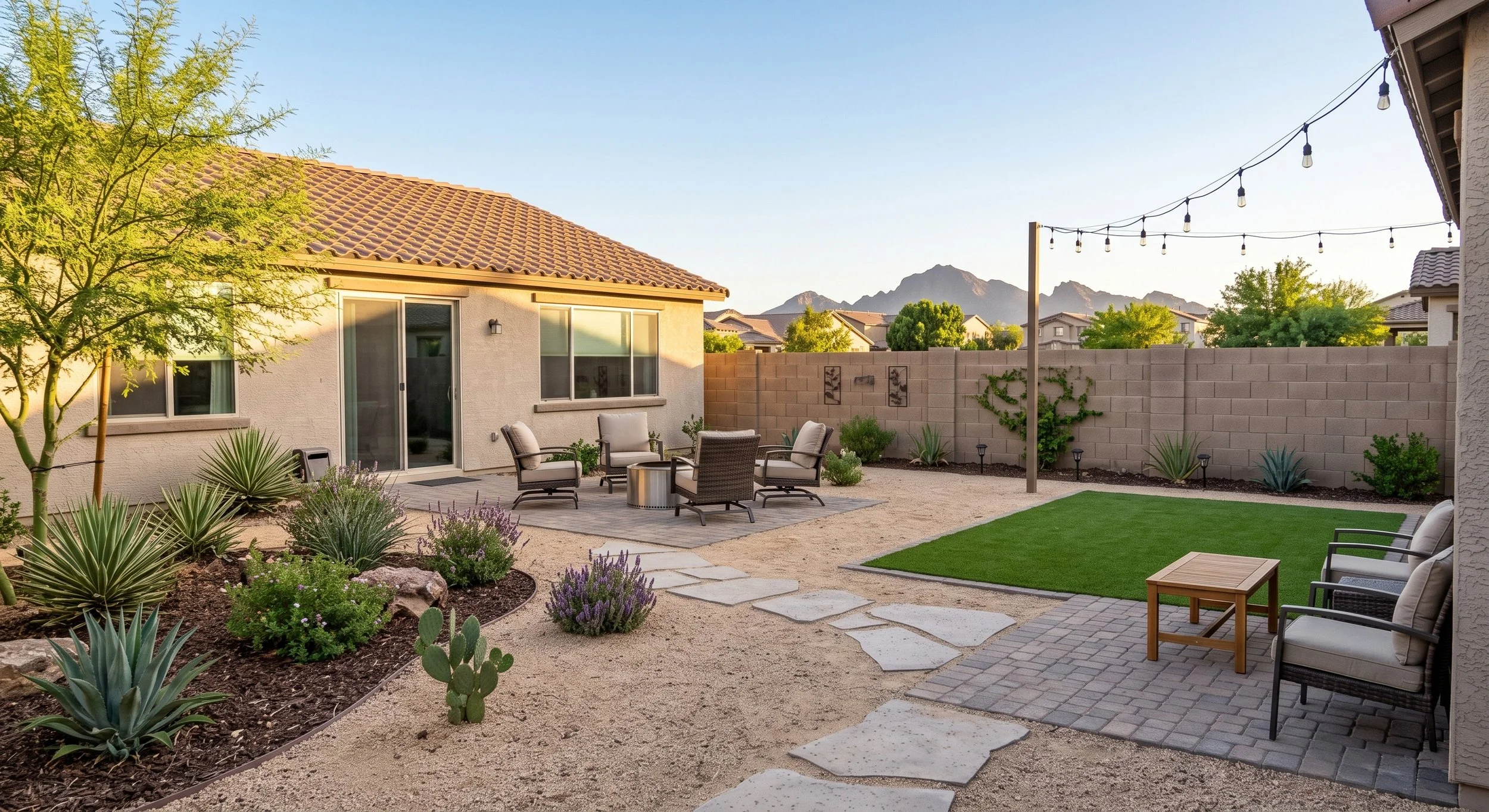
A focused approach might look like this: Imagine a typical Phoenix backyard — a covered patio attached to the house, but beyond it mostly gravel, sparse planting, and an open area with no real purpose. Instead of demolishing everything, the design keeps what already works and builds around it: the existing patio stays, a new paver area extends the usable gathering space, one well-placed desert tree begins providing real afternoon shade, planting beds soften the perimeter, landscape lighting adds atmosphere after dark, and one focal element — maybe a simple fire feature — finally gives the yard a destination.
That's the whole strategy: one strong space instead of three mediocre ones.
What I'd prioritize, in order: layout first, shade second, one strong gathering space third, planting and atmosphere last. Existing conditions matter a lot here — a usable patio, healthy trees, working irrigation, or walls that don't need to be touched all free up more of the budget for things you'll actually notice.
A well-designed $25K backyard doesn't need to feel cheap. It should feel intentional.
What Could a $50,000 Phoenix Backyard Look Like?
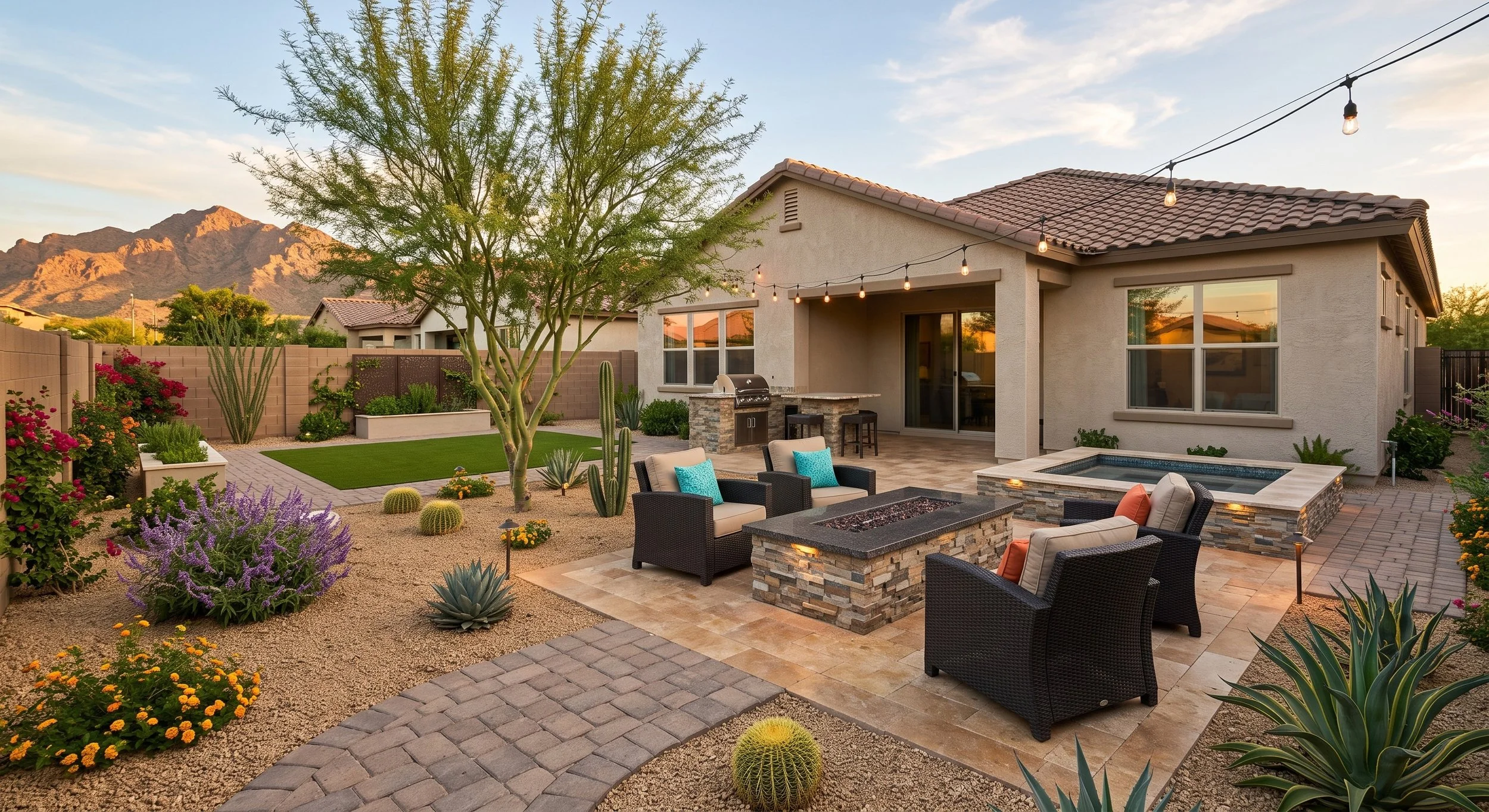
At $50,000, the design conversation starts to change shape. Instead of improving one part of the yard, there's usually enough room to build relationships between several spaces — an expanded patio, a separate fire lounge, a defined turf or play area, planting throughout, better lighting, and improved circulation tying it all together.
The operative word is connection. You're no longer just installing features — you're designing an environment.
Picture it: stepping out onto an expanded patio with a dining area close to the kitchen, a pathway leading to a small fire lounge, a tree canopy beginning to shade the western exposure, a defined turf area for kids or pets, and planting that separates each zone without making the yard feel crowded. None of it needs to be extravagant — it feels finished because it was designed as one composition, not assembled piece by piece.
Could $50K include a pergola or an outdoor kitchen? Possibly, but this is where trade-offs start to matter. Substantial shade structures and built-in outdoor kitchens can each represent a meaningful chunk of a budget this size once foundations, utilities, and finishes are factored in — so a $50K budget more often supports one major feature done well, alongside broader landscape improvements, rather than several done halfway. A bigger pergola with a simple freestanding grill and strong planting will usually beat a full built-in kitchen paired with a bare, unfinished yard around it. Neither is wrong — it depends entirely on how you actually use the space, which is a design question worth answering before construction starts, not during it.
What Could a $100,000 Phoenix Backyard Look Like?
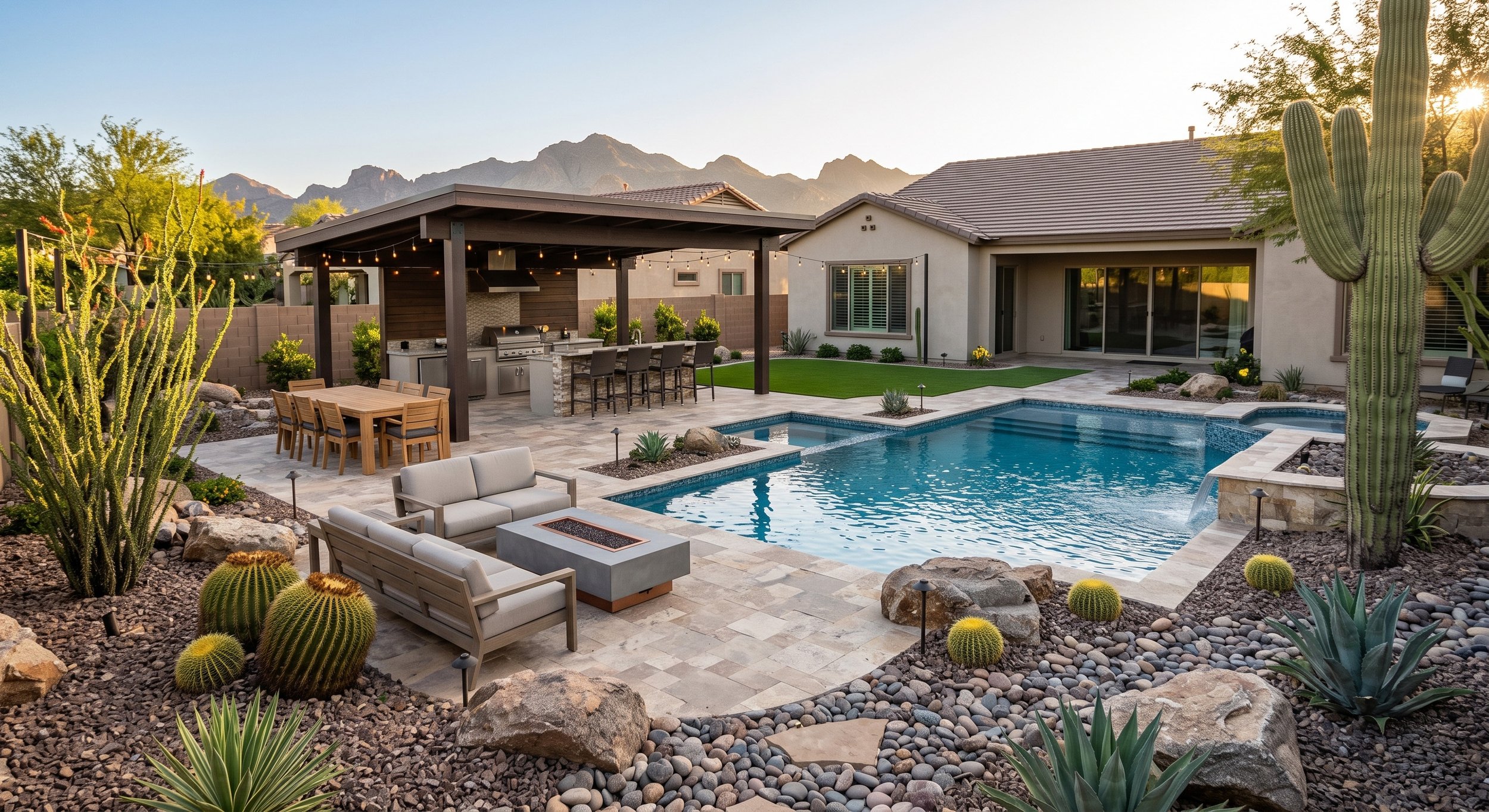
At roughly $100,000, a backyard can become a genuinely comprehensive outdoor-living environment — not because every luxury feature fits, but because there's real flexibility to coordinate several substantial elements into one design: larger hardscape areas, a real shade structure, an outdoor kitchen, a fire lounge, turf or recreation space, mature planting, upgraded lighting, and multiple gathering zones.
Picture it: a shaded dining terrace off the back door, an outdoor kitchen nearby, paving that transitions into a second outdoor room built around a fire feature, a quiet lounge under desert trees, an open turf area elsewhere, and planting that wraps the perimeter and frames the views worth keeping. At this scale you're not designing a patio with landscaping around it — you're designing a sequence of outdoor rooms, and the more of those relationships exist, the more the planning phase matters.
Does $100K include a pool? It can — but the rest of the yard will look very different depending on the answer. A new pool can consume a large share of a six-figure budget on its own, especially once spas, upgraded decking, and premium finishes enter the picture. Two homeowners with identical $100K budgets — one building a pool, one not — will end up with very different backyards, which is exactly why "I have $100K for my backyard" doesn't actually answer the more useful question: what do you want that $100K to accomplish?
Why Two $50K Phoenix Backyards Can Look Completely Different
This is the part of budgeting that catches people off guard.
Two homeowners each have exactly $50,000.
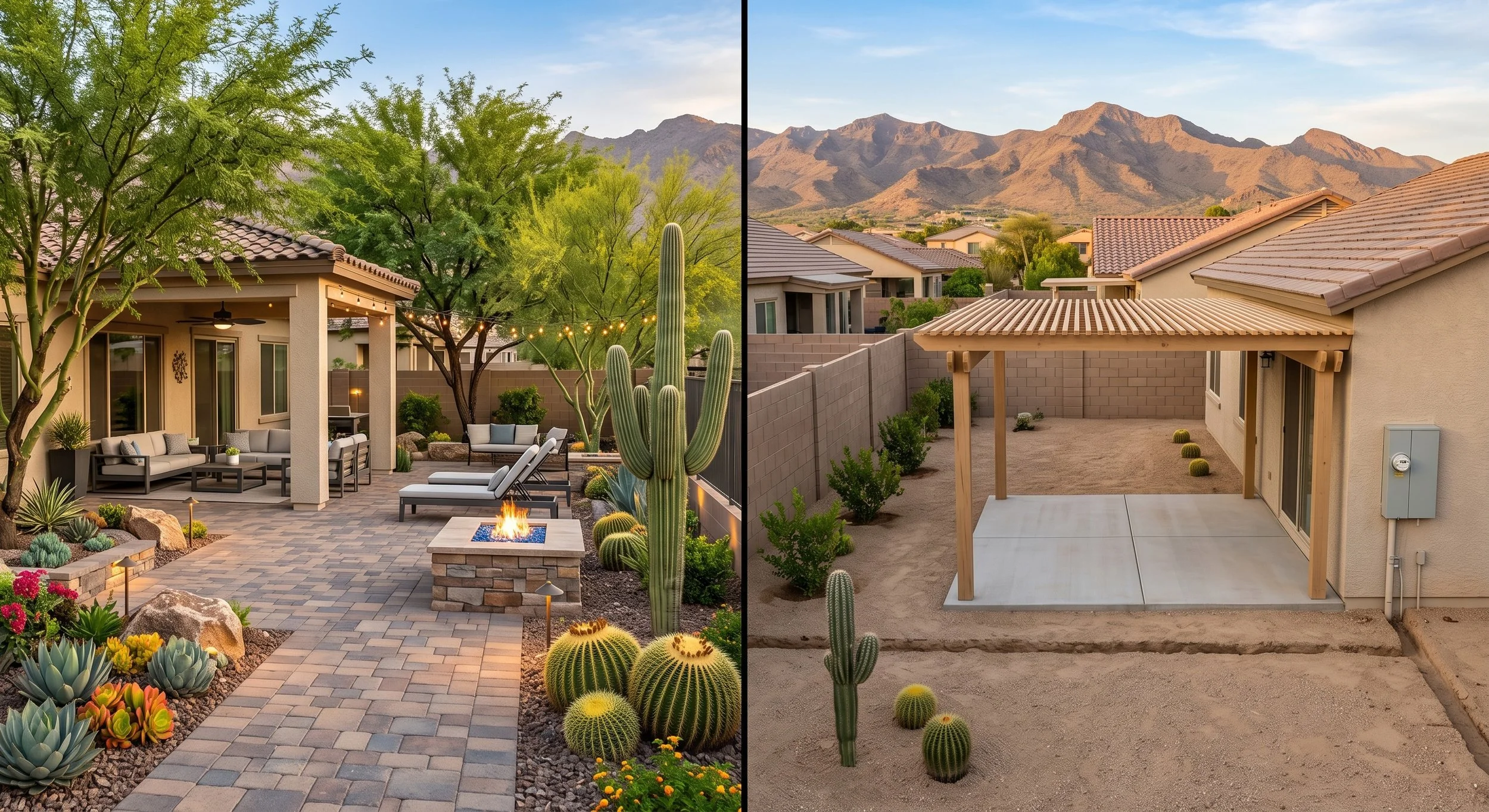
Homeowner A's property already has a usable covered patio, healthy mature trees, working irrigation, good drainage, and easy site access. Almost all of that $50K can go toward things they'll actually see and enjoy.
Homeowner B's property needs old concrete removed, grading corrected, irrigation replaced, and utility lines extended before anything visible can even begin — plus difficult access that slows everything down.
Same budget. Completely different starting point. Homeowner B may end up spending a large share of the money on work that's essential but invisible once the project is done.
That's why judging backyard costs by photos alone is misleading — you're seeing the finished result, not what had to happen underneath it first.
What Actually Drives Cost in a Phoenix Backyard?
A handful of factors can push a project from one budget tier into the next faster than people expect:
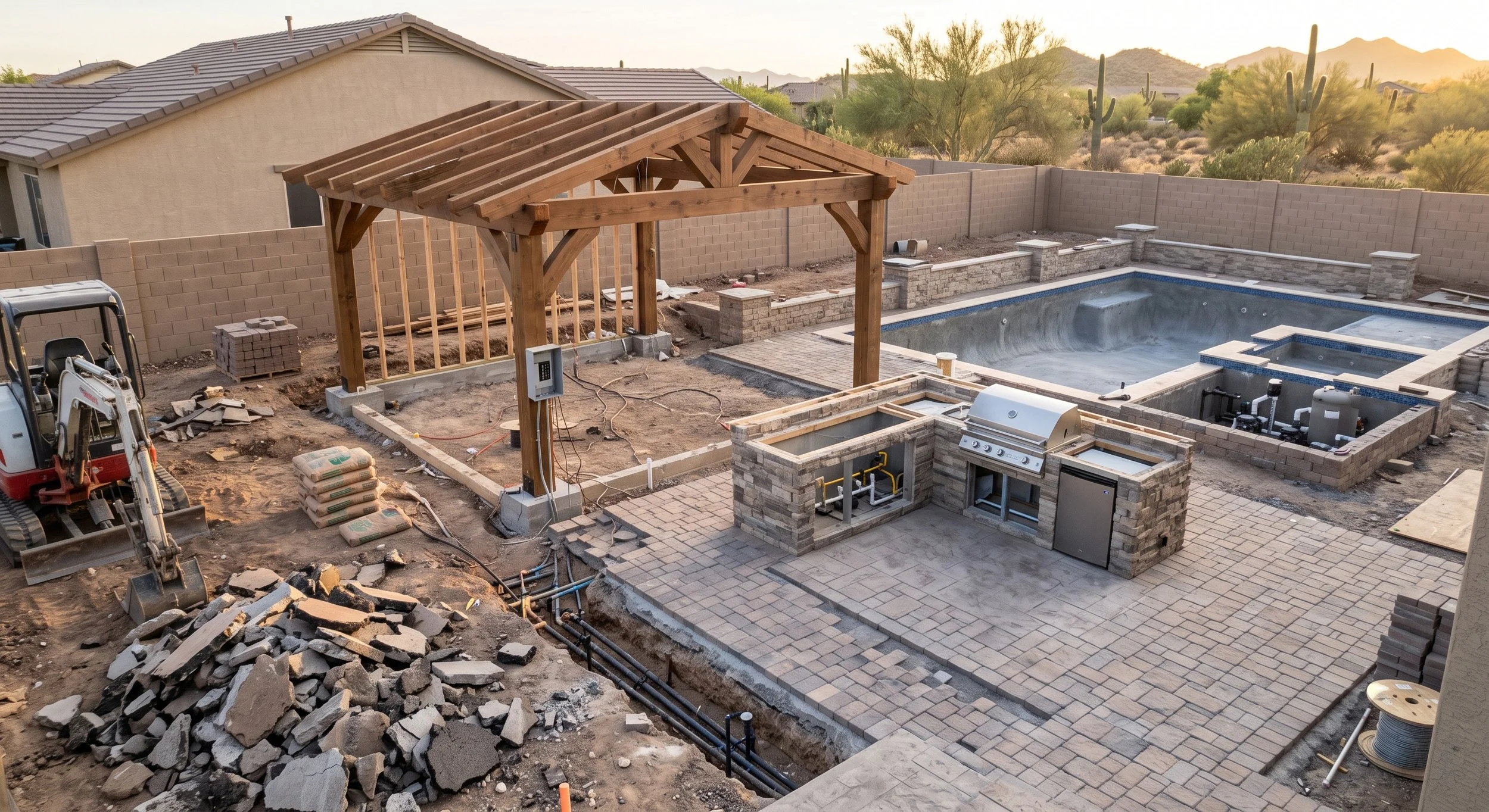
Hardscape — pavers, concrete, walls, and masonry require both material and labor, plus excavation, base prep, grading, and drainage work that never shows up in a photo.
Shade structures — pergolas and ramadas become significant line items once foundations, framing, electrical, and engineering enter the scope.
Outdoor kitchens — there's a large gap between a grill near the patio and a full built-in kitchen with plumbing, gas, electrical, and premium appliances.
Demolition and site prep — removing old concrete, correcting drainage, and reworking irrigation costs real money without producing a dramatic "after" photo.
Pools, spas, and specialty features — these can shift a project's entire budget category on their own.
Asking "how much does a backyard cost?" is a lot like asking "how much does a house cost?" — the honest answer depends entirely on what you're building.
The Biggest Budget Mistake: Designing From a Feature Checklist
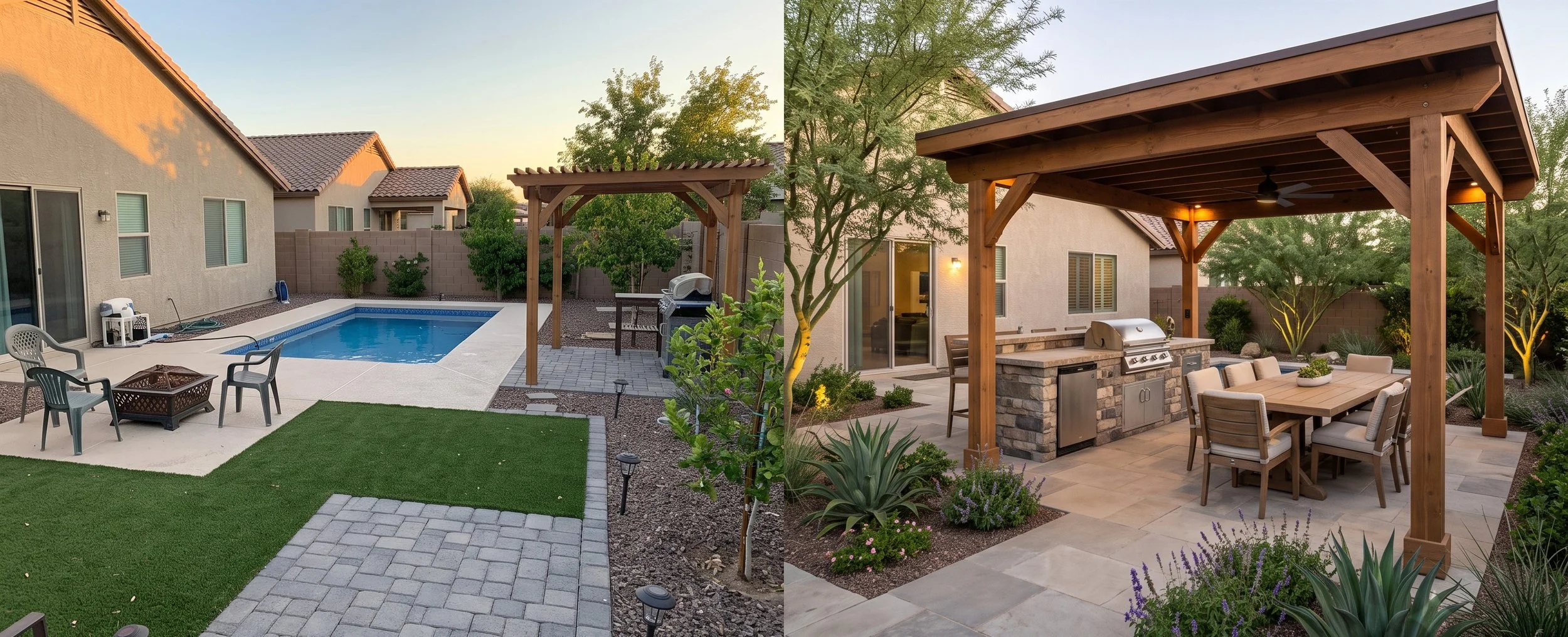
Pool. Pergola. Outdoor kitchen. Fire pit. Turf. Pavers. Trees. Lighting. Water feature.
It's easy to start with a list like that and try to squeeze all of it under one number. The better starting question is:
What do we actually want this backyard to do for us?
If you entertain often, dining, shade, and circulation deserve the bigger share of the budget. If you rarely host but want somewhere peaceful in the evenings, a well-shaded lounge surrounded by planting will likely matter more than an elaborate kitchen. If you have young kids, flexible open space may beat premium hardscape. If your yard takes brutal western sun, shade might be the single highest-value thing you can buy.
Budget should follow priorities — not a checklist.
A $25K Backyard Can Be Better Designed Than a $100K Backyard
This sounds backwards, but it's true.
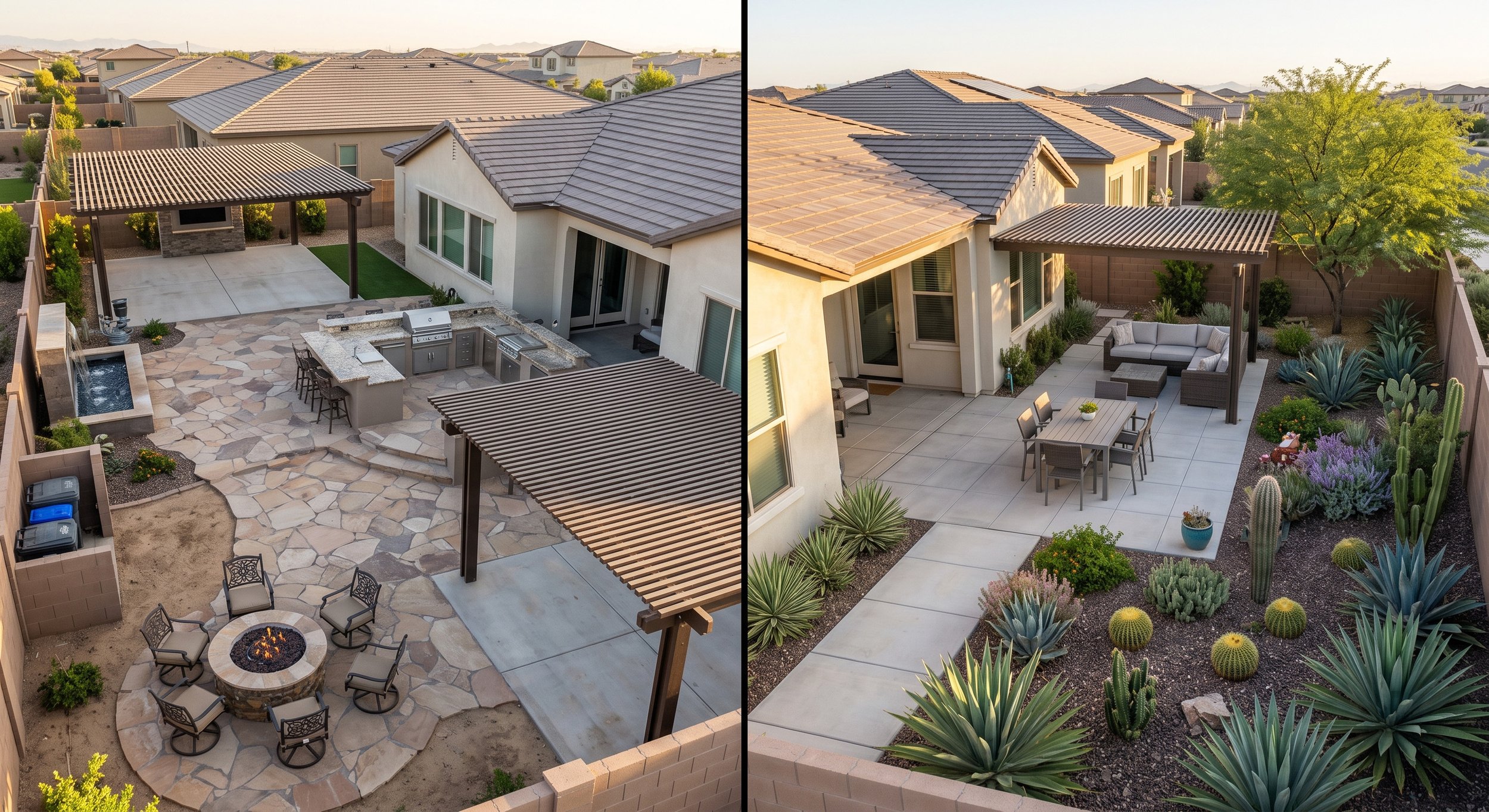
Money buys materials, labor, features, and scale. It does not automatically buy good design. You can spend $100,000 on expensive elements that don't relate to each other — the kitchen blocks circulation, the fire pit sits in a leftover corner, the pergola shades a spot nobody wants to sit in. Everything is expensive, and nothing feels connected.
Meanwhile, a much simpler backyard can have one beautiful gathering space positioned exactly where it should be, the right amount of shade, thoughtful planting, and a real relationship between the house and the yard — and it just feels right.
Good landscapes have a hierarchy: somewhere your eye naturally goes, a clear place to gather, movement that feels intuitive, planting that supports the architecture instead of fighting it. The yard reads as one composition, not a catalog of features. That's what design is actually for.
Should You Design the Backyard Before Getting Construction Bids?
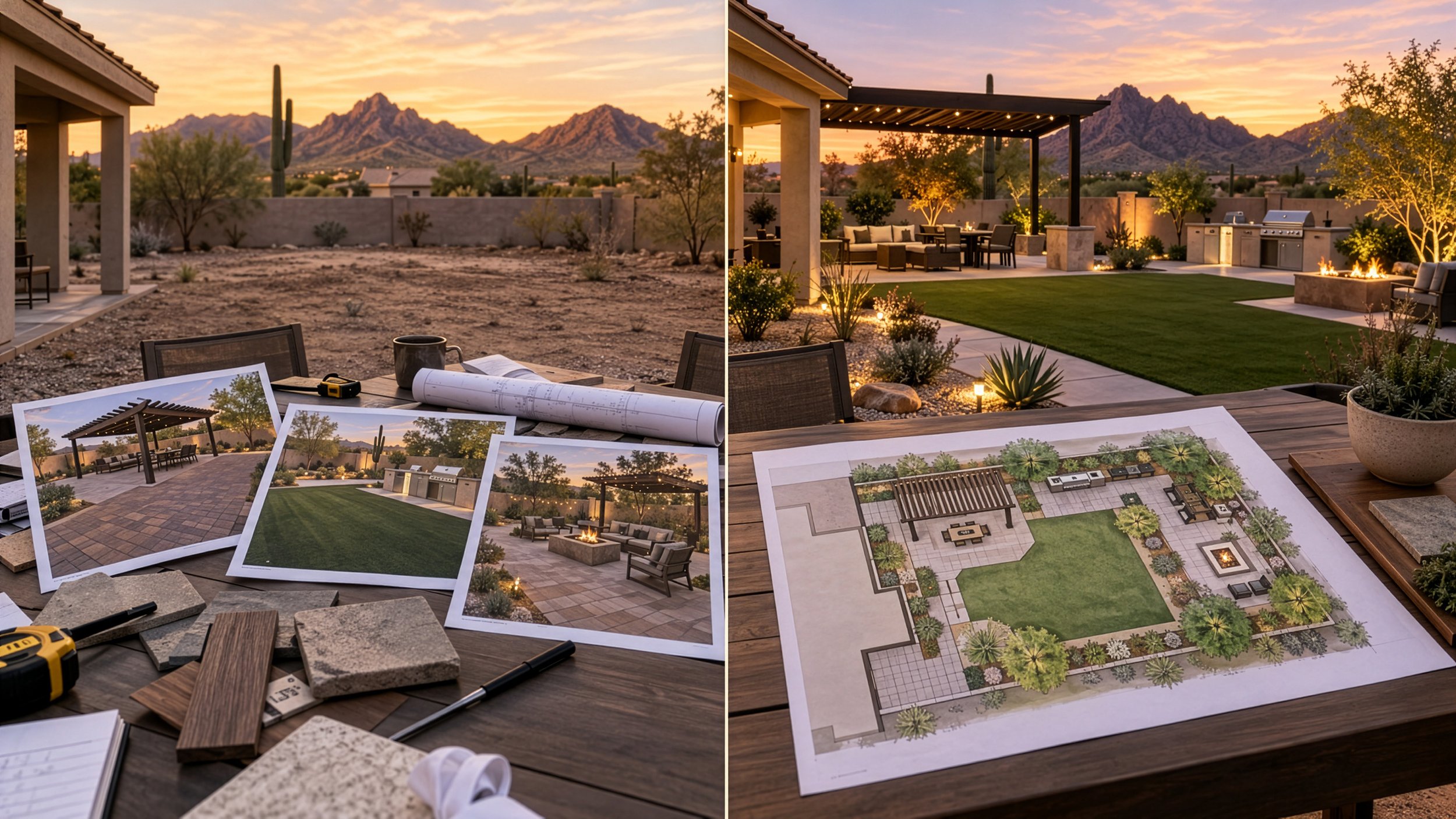
Call three Phoenix contractors and say, "I have $50,000 — what can you do?" and you'll likely get three completely different visions: one imagines a paver patio and pergola, another imagines turf and an outdoor kitchen, a third proposes a fire feature and a large entertainment patio. Those aren't three prices for the same project — they're three different projects.
Establish the design direction first, and the conversation changes. You already know roughly where the patio belongs, where shade matters most, how big the turf area should be, and which features are priorities versus future phases. Now you can ask contractors a much sharper question: what would it cost to build this?
What If Your Dream Backyard Costs More Than Your Budget?
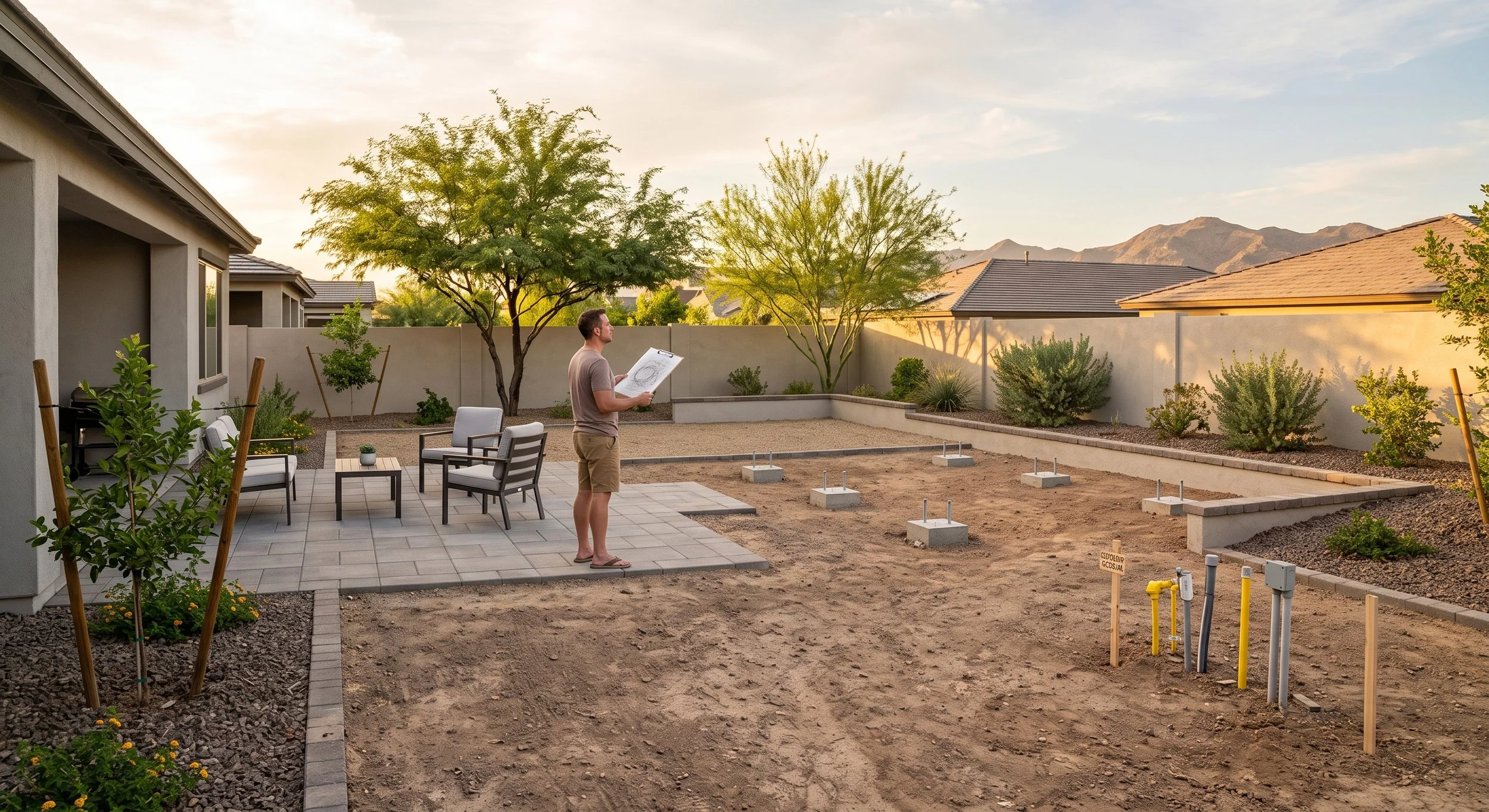
That doesn't mean the design failed — it usually just means the project needs to be phased. A plan built for the long term might sequence things like: Phase One establishes the patio, drainage, irrigation, and major trees; Phase Two adds the shade structure; Phase Three adds the outdoor kitchen or fire lounge.
The order depends on the project, but the key is knowing where future elements belong before the first phase gets built — so this year's work doesn't quietly make next year's harder or more expensive.
So Which Budget Is Right for You?
A $25,000 backyard isn't automatically too small. A $100,000 backyard isn't automatically luxurious. The number only means something once it's connected to your property, your priorities, and what you actually want the space to do. Your project may land squarely in one of these tiers — or comfortably between them.
How Desert Curb Studio Approaches Backyard Budgets
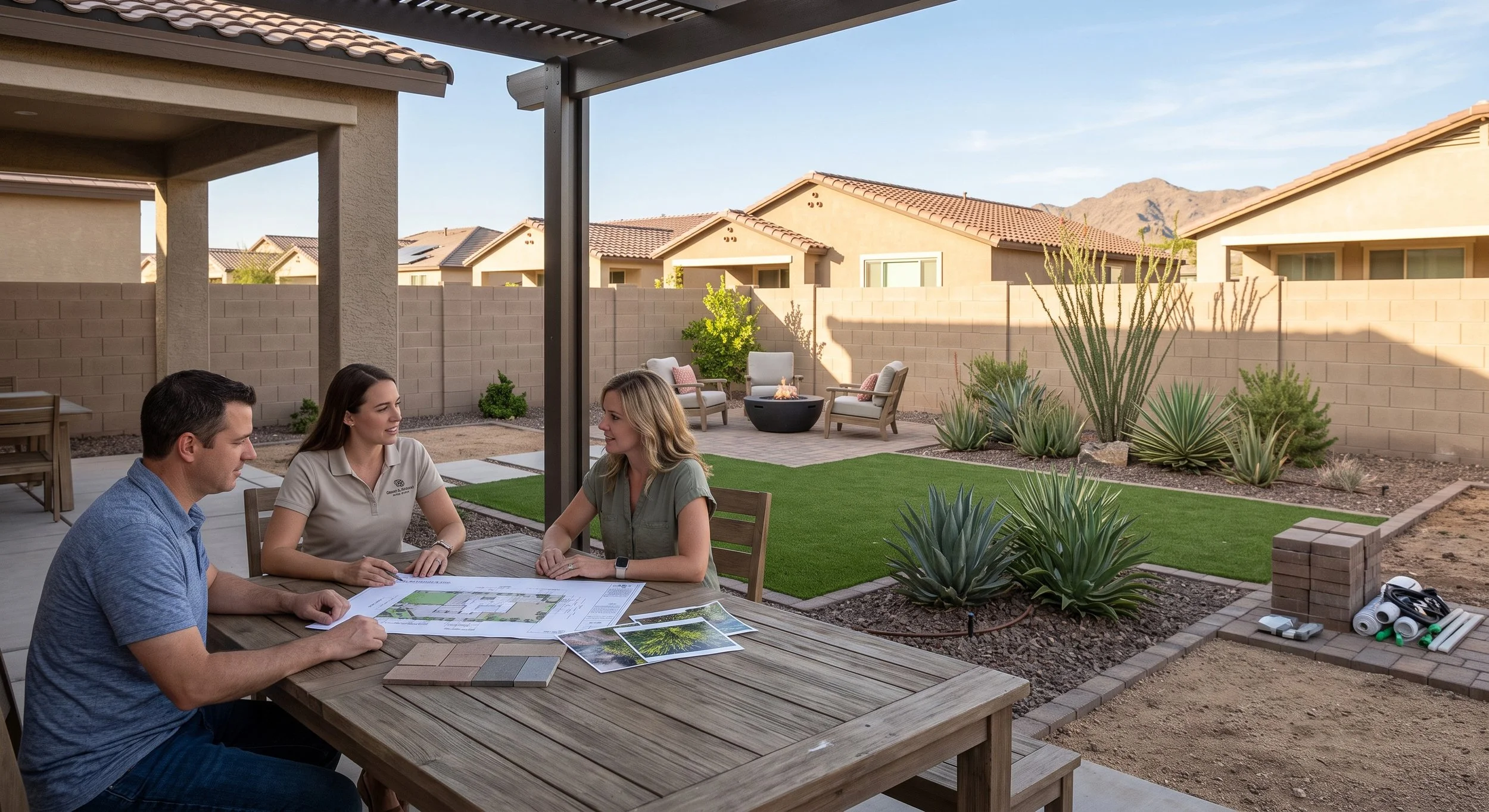
We don't start by asking how many features fit into your yard. We start by understanding how you actually want to use it — whether you entertain often, need more shade, have kids or pets, and what isn't working about the yard today. From there, the design process explores layout, outdoor living zones, planting, materials, and phasing, so that whatever your budget is, it gets spent with intention rather than guesswork.
The goal was never to hand you a construction quote. It's to hand you a clear enough direction that contractors can finally price the right project instead of three different guesses at one.
Not sure what your budget could actually become? That's a completely normal place to start. The first step at Desert Curb Studio is a complimentary Discovery Call, where we talk through your property, your priorities, and what you're hoping the finished yard becomes.
Start with the vision. Prioritize what matters. Then build with confidence.
Schedule your complimentary Discovery Call with Desert Curb Studio.
Construction-cost context in this article reflects publicly published Phoenix-area contractor pricing guides, reviewed September 2026. These figures are cited for general market context only; Desert Curb Studio does not endorse or guarantee third-party pricing, and actual costs will vary by contractor, property, and scope.